Learning Theories, strategies and styles
Literature review
Studies related to how a person learns and how learning can be efficient have a long history. Various theories and approaches have been developed in this field and they have had important impact on endeavors for learning. Pedagogues make a classification based on three basic approaches while dealing with learning theories. These are behaviorist approach, cognitive approach and constructivism. It will be a mistake to see these three approaches as alternative to each one or to evaluate them independently while making a classification. Behaviorist, cognitive and constructivist ideas and principles overlap in many fields. (Ahmet, 2016)
I shared this class with my mentor and during the class, we make sure we stimulate students to do what is correct and reward students showing others that it is always possible to do better if we focus on our tasks.
Behavoriorism
Behaviorist Approach First of all, behaviour is composed of reactions and movements that an organism gives and does in a certain situation. The term, behaviour is mostly used for actions that can be observed from outside. Behaviorist learning approach mostly focuses on how behaviours are acquired. Behaviorist approach claims that learning can develop by means of establishing a connection between stimulus and behaviour, and that any behaviour can be changed through reinforcement.
Cognitive development
Literature Review
Cognitive development
The studies of cognitive development deal with how thinking processes of children change in time. Cognition includes the acquisition and usage of the knowledge. Cognition includes not only the processes, which are purposeful and needs diligence bearing decision within but also processes that automatically performed and unconsciously remembrance of any familiar face and object. Cognition cannot be observed directly but it is understood as a result of behaviors. Development defines the changes in construction and function. (Ahmet, 2016)
I shared this class with my mentor and in the end, the students talked about the knowledge they applied during the practice of the lessons.

In the video, the student is explaining the importance of having a good base to maintain safety during the bridge, as we see in the picture. During the lesson, they easier do because they associate the new knowledge ( do a bridge with support by having someone as a base and another one to support) with their prior ones ( if they have a weak base there are more possibilities to get injured, and the person above can fall easily).
Contructivism
Constructivism is a theory of learning that has roots in both philosophy and psychology. The essential core of constructivism is that learners actively construct their own knowledge and meaning from their experiences (Fosnot, 1996; Steffe & Gale, 1995).
To make sure that students construct their knowledge effectively during our classes we give opportunities to students to learn by doing activities. In the video, they created their routines combining different exercises that they choosed.
MYP - Evidence
Behavioral learning theory of pavlov
How do I transfer pavlov theory of learning into my lessons
Behaviourism, as we have seen, emerged in order to take a closer look at behaviour so that we can predict and control it. In my lessons, I face different behaviours among the students and the Pavlov theory helped me to find strategies that can be helpful for the students. One of them is to recognize the students after they do any activity or behave well so that others can follow the example. This method works very well, simple congratulation, high five, good job and well done motivate the students very well.
Reinforcement learning
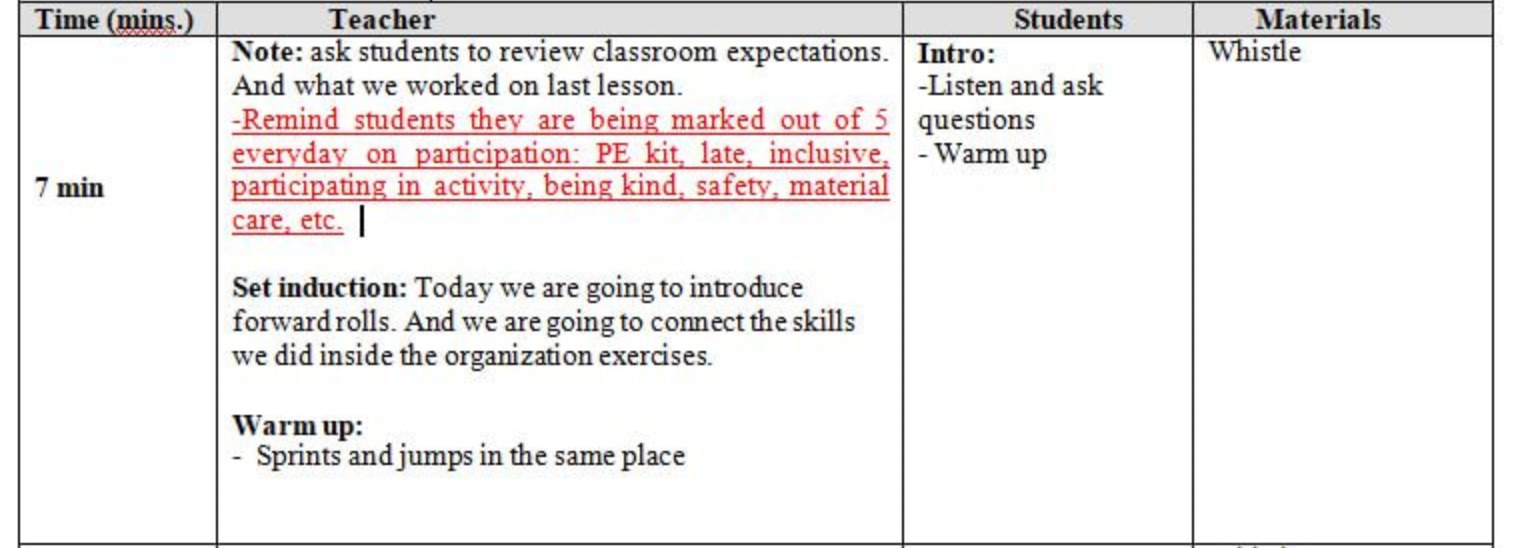
Every lesson I reinforce positive behaviour, I make sure the first minutes I remind them how are they supposed to behave in class. And I keep that written. See the template I use to record their points per lesson on my action research Cycle 4.
However, Skinner (1974) addressed his main criticisms of the academic environment. According to him, the way reinforcement was practised in schools was not ideal.
Rather than punishing the student who occasionally behaved inappropriately, it would be appropriate to praise and encourage his best-behaved peers.
I use to think that spending time with the students that behave inappropriately it was more efficient but after I tried the opposite, recognizing the ones are behaving well, I realised that this has more influence on the others that are not doing well and they try to also be recognized for good practices.
COGNITIVE DEVELOPMENT
During this lesson, I had 2 students with the same difficulties, while they were tying forward roll. While they were giving me feedback they mention that they were afraid to turn, because of that, they bend one arm on the time of the turn and that makes them not turn. So after I explained they tried to buy themself, and then in their groups but they didn't manage to do. So I decided to help them, supporting them on the time they do the turn, One manages to do with my support and after that, she manages to do alone.
But the other one it was different, the first video in left shows my student bending the arm while I am helping him, I even tried to ask one of the colleagues to help to hold the hand but it was not successful. He told me that he can't even control the arm, he did understand the moment that the arms bend even after I show him that he is safe. I told the colleague that went through the same problem to share the experience but I didn't have the different result he still have the same problem. I will continue looking in different ways of helping in this situation for my future students.